
Skip to Main Content Skip to Main Navigation
Hands Forming a Heart
academics accessibility alert arts backpack calendar camera careers circle-check circle pointing down clock contact envelope Facebook fax cellphone inside circle slash file globe globe grades help information link off location lunch Connect Notify NYC Department of Education office worker office worker One Plus Three phone question rss school school-high search sports students Sun transportation Twitter Twitter user Vimeo world information Graduation Hat
file-pdf file-word file-word file-excel file-excel ar bn 中文 - 简体 中文 - 简体 ko ru ur en fr-FR fr-HT es Español

The site navigation utilizes arrow, enter, escape, and space bar key commands. Left and right arrows move across top level links and expand / close menus in sub levels. Up and Down arrows will open main level menus and toggle through sub tier links. Enter and space open menus and escape closes them as well. Tab will move on to the next part of the site rather than go through menu items.

NYC Public Schools stacked logoNYC Public Schools logo
  • Enrollment
    • Enroll Grade by Grade
    • Enrollment Help
    • Enroll in Charter Schools
    • Summer Rising
    • Other Ways to Graduate
    • NYC Bright Starts
    • Enrollment Feedback
    • Enroll Grade by Grade
    • Infant and Toddler
    • 2-K
    • 3-K
    • Pre-K
    • Kindergarten
    • Gifted and Talented
    • Middle School
    • High School
    • Specialized High Schools
    • How Students Get Offers to DOE Public Schools
    • Waitlists
    • District 75
    • Enrollment Help
    • Family Welcome Centers
    • Meeting Student Needs
    • New Students
    • Transfers
    • Home Schooling
    • Enrollment Forms
    • Enroll in Charter Schools
    • Learn About Charter Schools
    • How to Enroll in Charter Schools
    • Pre-K Charter Schools
    • Other Ways to Graduate
    • Learn About Other Ways to Graduate
    • Alternative Middle Schools
    • Young Adult Borough Centers
    • Transfer High Schools
    • High School Equivalency (Ages 17-21)
    • Adult Education (Ages 21 plus)
    • Kindergarten
    • Elementary Admissions Events
    • High School
    • High School Auditions
    • Screened Admissions
    • Assessments for Screened Schools
    • Educational Option (Ed Opt) Admissions Method
    • Types of High Schools
    • Offer Chances
    • Specialized High Schools
    • Discovery Programs
    • How Students Get Offers to DOE Public Schools
    • Random Numbers in Admissions
    • Meeting Student Needs
    • Enrollment for LGBTQ and Gender Nonconforming Students
    • Enrollment for Students with Disabilities
    • Enrollment for Students with Accessibility Needs
    • Enrollment for Students Learning English
    • Diversity in Admissions
    • Non-Resident Enrollment
    • Transfer High Schools
    • Transfer Schools Guide
    • High School Equivalency (Ages 17-21)
    • Enroll in High School Equivalency Classes (Ages 17-21)
  • Find a School
  • Learning
    • Special Education
    • Multilingual Learners
    • Digital Learning
    • Subjects
    • Testing
    • Student Journey
    • Programs
    • Special Education
    • Family Resources
    • The IEP Process
    • Supports and Services
    • School Settings
    • Preschool to Age 21
    • Help
    • Building Accessibility
    • Boldly Reimagining Special Education
    • Due Process: Impartial Hearings and Mediation
    • Equitable Services (IESP) Assistance
    • Impartial Hearing Order Implementation
    • Multilingual Learners
    • Annual Parent Teacher Meetings for English Language Learners
    • Bill of Rights for Parents of English Language Learners
    • College-Career Readiness for English Language Learners
    • Community Organizations that Help Multilingual and Immigrant Families
    • English Language Learners
    • Multilingual and Immigrant Student Support Resource Site
    • Multilingual NYC
    • New York State Seal of Biliteracy
    • Programs for English Language Learners
    • Summer for Multilingual Learners
    • Tests for English Language Learners
    • Translated Support for Digital Learning
    • Welcoming and Inclusive Schools for Multilingual and Immigrant Communities
    • Digital Learning
    • Digital Learning Devices
    • Applications and Platforms
    • NYCPS Accounts
    • Digital Citizenship
    • Microsoft Software
    • Subjects
    • Arts
    • Civics for All
    • Computer Science
    • English Language Arts
    • Health Education
    • Libraries
    • Literacy
    • Math
    • Physical Education
    • Science
    • Social Studies
    • STEM
    • Testing
    • NY State English Language Arts Test
    • NY State Math Test
    • NY State Science Test
    • NY State Alternate Assessment
    • NY State High School Regents Exams
    • Tests for English Language Learners
    • World Languages
    • Specialized High School Admissions Test
    • College Entrance Exams
    • Advanced Placement Exams
    • High School Equivalency Exam
    • Periodic Assessments
    • Testing Calendar
    • Arts Commencement Assessments
    • Student Journey
    • Bridge Coach
    • Career-Connected Learning
    • College and Career Planning
    • Experiential Learning
    • Grade by Grade
    • Grading
    • Graduation Requirements
    • NYC Schools Account
    • Promotion Policy
    • Student Records and Transcripts
    • FutureReadyNYC
    • Advanced Courses
    • Programs
    • Wellness Wednesday NYC
    • Community Schools
    • NYC Great!
    • NYC Urban Ambassadors
    • DREAM Program
    • Medically Necessary Instruction
    • District 79 (Alternate Learning Center)
    • RISE
    • Single Shepherd
    • PROSE
    • Outdoor Learning Initiative
    • NYC Mentoring Program
    • Success Via Apprenticeship (SVA) Program: CTE Teacher Preparation
    • Family Resources
    • Special Education Supports
    • Beyond Access
    • The IEP Process
    • Starting the Process
    • Making a Referral
    • Evaluation
    • IEP Meeting
    • The IEP
    • Parent Members
    • Supports and Services
    • Assistive Technology
    • Behavior Supports
    • Related Services
    • Specialized Transportation
    • Other Special Education Services
    • Testing Accommodations
    • Extended School Year Services for July and August
    • Building Accessibility
    • School Settings
    • District Schools
    • Specialized Programs
    • District 75
    • Other Educational Settings
    • Preschool to Age 21
    • Special Education in NYC
    • Preschool Students
    • Kindergarten Students
    • Students with Disabilities and Gifted and Talented
    • Middle School Students
    • High School Students
    • Transition from High School
    • Help
    • Talking About Disability
    • Your Rights
    • Contacts and Resources
    • Special Education Glossary
    • Committees on Special Education
    • Resources for Staff and Providers
    • N.G. by F.E. v. New York City Department of Education, et al.
    • J.S.M. vs DOE Notice of Class Action Settlement
    • Boldly Reimagining Special Education
    • Inclusive Schools
    • Due Process: Impartial Hearings and Mediation
    • Due Process Rights
    • Getting Support
    • Impartial Hearings
    • Mediation
    • Important Notices
    • Digital Learning Devices
    • Your DOE-loaned Device
    • iPad Fixes
    • Lost or Stolen Devices
    • Device Returns
    • Technical Support for Families
    • Free and Low-Cost Internet Options
    • Applications and Platforms
    • TeachHub
    • One Account for All
    • New York City Schools Account (NYCSA)
    • MySchools
    • SupportHub
    • Google Classroom
    • Microsoft Teams
    • Parent U
    • Zoom
    • iLearnNYC
    • WeLearnNYC
    • WeTeachNYC
    • Tools for Keeping Children Safe Online
    • Arts
    • How to Make a Visual Arts Portfolio
    • How to Prepare for a Theater Audition
    • How to Prepare for a Dance Audition
    • How to Prepare for a Music Audition
    • Health Education
    • Health Education Requirements
    • Literacy
    • Literacy Advisory Council
    • NYC Reads
    • Literacy Resources for Families
    • Math
    • NYC Solves
    • Physical Education
    • Physical Education Requirements
    • Social Studies
    • Current Events
    • Hidden Voices
    • Black History Month
    • Women's History Month
    • Arab American Heritage Month
    • Asian American and Pacific Islander Heritage Month
    • Jewish American Heritage Month
    • Caribbean American Heritage Month
    • Pride Month
    • Juneteenth
    • Disability Pride Month
    • Hispanic Heritage Month
    • Native American Heritage Month
    • STEM
    • Minecraft Education Challenge
    • College Entrance Exams
    • SAT School Day
    • Career-Connected Learning
    • Career Readiness and Modern Youth Apprenticeship (CRMYA)
    • Career and Technical Education (CTE)
    • NYC P-TECH (Grades 9-14): Early College and Career Schools
    • College and Career Planning
    • Applying to College
    • College Awareness Day
    • Exploring Future Careers
    • Paying for College
    • NYC Kids RISE Save for College Program
    • Free College and Career Advising
    • College Information for Immigrant Students
    • College and Career Glossary
    • National Student Clearinghouse Notice and Opt Out Form
    • Experiential Learning
    • Genovesi Environmental Study Center
    • NYC Center for Aerospace and Applied Mathematics
    • Service in Schools
    • Grade by Grade
    • Early Childhood Learning
    • Elementary School Learning
    • Middle School Learning
    • High School Learning
    • NYC Schools Account
    • NYCSA Mobile Application
    • Student Records and Transcripts
    • Requesting Student Records and Transcripts
    • Report Cards
    • Wellness Wednesday NYC
    • Wellness Wednesday NYC Activity
    • Special Education Supports
    • Assistive Technology
    • Occupational Therapy Supports
    • Physical Therapy Supports
    • Speech Therapy Supports
    • Related Services
    • Finding an Independent Provider
    • District 75
    • District 75 Programs
    • Transition from High School
    • Transition Summit 2026
    • Your DOE-loaned Device
    • iPad Data
    • Sign in to Zscaler
    • TeachHub
    • TeachHub Mobile Application
    • NYC Reads
    • English Language Development Curriculum
    • Early Childhood Learning
    • Early Childhood Resources
    • Early Literacy Resources
    • Family Child Care
  • School Life
    • Accessibility at the DOE
    • Health and Wellness
    • Food
    • Transportation
    • Know Your Rights
    • School Environment
    • Safe Schools
    • Special Situations
    • Space and Facilities
    • Summer 101
    • Accessibility at the DOE
    • Building Accessibility
    • Accessibility Support on iPads and Other Devices
    • Accessibility Statement
    • Enrollment for Students with Accessibility Needs
    • Local Law 12
    • Health and Wellness
    • Staying Healthy
    • Health Services
    • Health Requirements to Attend School
    • Immunizations
    • 504 Accommodations
    • Mental Health
    • School-Based Health Centers
    • Sports and Staying Active
    • Condom Availability Program
    • Menstrual Products for Students
    • Food
    • School Meals
    • Menus
    • Food Programs
    • Menu Nutrition Information
    • Charter and Non-Public Schools Food Service
    • Summer Meals
    • Transportation
    • Transportation Overview
    • Transportation Eligibility
    • Student OMNY Cards
    • NYC School Bus App
    • Summer Transportation
    • Transportation Guide
    • Safe Travel Tips
    • Family Responsibilities and Expectations
    • Transportation Rights
    • Weather Emergency Procedures
    • Contact Information
    • Know Your Rights
    • Chancellor's Regulations
    • Discipline Code
    • Parents' Bill of Rights
    • Parents' Bill of Rights for Data Privacy and Security
    • Other Policies
    • Project Open Arms
    • Student Privacy
    • School Environment
    • NYC Public Schools Speak Your Language
    • Understanding Respect for All: NYCPS's Commitment to Safe and Supportive Learning Environment
    • Digital Citizenship
    • After-School
    • Attendance
    • School Counselors
    • LGBTQ Supports
    • Get Help
    • Get Help at Your Charter School
    • Guidelines on Gender
    • Dress Code Guidelines
    • Immigrant Families
    • Project PIVOT
    • Safe Schools
    • Anti-Hate Hotline/Incident Reporting Pathways
    • Bullying / Respect for All
    • Emergency Readiness
    • Gang Prevention and Intervention
    • Resilient Kids, Safer Schools
    • School Safety
    • Suspensions
    • Special Situations
    • Child Abuse
    • Court-Involved Youth
    • Crisis or Traumatic Event
    • Responding to Behavioral Crises
    • Services for Student Parents
    • Students in Foster Care
    • Students in Temporary Housing
    • Substance Misuse
    • Space and Facilities
    • Building Accessibility
    • Local Law 12
    • Campus Governance
    • District Planning
    • School Buildings
    • Space and Facilities Reports
    • Sustainability
    • School Construction
    • Staying Healthy
    • Allergies
    • Asthma
    • Concussions
    • Diabetes
    • Head Lice
    • Other Health Topics
    • Dental
    • Health Services
    • School Vision Program
    • Sports and Staying Active
    • CHAMPS
    • Public Schools Athletic League
    • School Meals
    • Food Service for Parents and Students
    • Food Service for School Principal and Charter Schools
    • Plant Powered Meals
    • Food Education Roadmap
    • Menus
    • Breakfast Meals
    • Lunch Meals
    • After School Meals
    • Food Benefits
    • Transportation Overview
    • Whats New
    • Student Transportation Call Center Updates
    • Transportation Eligibility
    • Exceptions to Transportation Eligibility
    • NYC Public Schools Speak Your Language
    • Sign Language Interpreting Services
    • Understanding Respect for All: NYCPS's Commitment to Safe and Supportive Learning Environment
    • Respect for All Handouts
    • Digital Citizenship
    • Social Media Guidelines for Students 12 and Younger
    • Parent Social Media Guide for Students 12 and Under
    • Social Media Guidelines for Students Over 13
    • Parent Social Media Guide for Students Over 13
    • Cybersecurity Awareness
    • LGBTQ Supports
    • Community-based LGBTQ Organizations
    • Get Help
    • Parent Complaints and Appeals
    • Get Help at Your Charter School
    • File a Formal Complaint at Your Charter School
    • Guidelines on Gender
    • Guidelines to Support Transgender and Gender Expansive Students
    • Guidelines on Gender Inclusion
    • Immigrant Families
    • Protocols for NonLocal Law Enforcement
    • School Safety
    • Parent Guide to School Safety and Emergency Preparedness
    • Students in Temporary Housing
    • E.G. v. City of New York (WiFi Case): Notice of Proposed Class Action Settlement
    • District Planning
    • District Planning Document Library
    • 2025-2026 Data Summaries
    • Space and Facilities Reports
    • Building Ventilation Status
    • Paint Inspections
    • Water Safety
    • Resources for Facilities Staff
    • Health and Safety
    • Sustainability
    • Climate Action Days
    • School Construction
    • Public Art for Public Schools
    • Public Schools Athletic League
    • Moises Jimenez et at v New York City Department of Education (Sports Equity Case): Notice of Proposed Class Action Settlement
    • Whats New
    • Bus Vendor Town Hall
    • File a Formal Complaint at Your Charter School
    • Charter School Authorizers
    • District Planning Document Library
    • Document Library Archive
    • Approved Rezonings
    • Paint Inspections
    • Bronx
    • Brooklyn
    • Manhattan
    • Queens
    • Staten Island
  • Get Involved
    • Students
    • Families
    • Students
    • NYC Youth Speaks
    • Student Opportunities
    • Student Advisory Councils
    • Student Bill of Rights
    • Working Papers
    • Demographic Survey
    • Families
    • New York City Schools Account
    • Education Councils
    • Family and Community Empowerment (FACE)
    • Family and Community Wellness Collective
    • Family Empowerment
    • Guidance on Public Meetings and School Visits
    • Panel for Educational Policy
    • Parent and Parent Teacher Associations
    • Parent-Teacher Conferences
    • School Leadership Team
    • School Wellness Councils
    • Education Councils
    • Community Education Councils
    • Citywide Education Councils
    • Elections 2025
    • Helpful Resources
    • Panel for Educational Policy
    • Panel Members
    • Governance Bylaws
    • Meeting Archives
    • Emergency Declarations
    • Meeting Schedule
    • Special Commissions
    • Resolutions
    • 2026-2027 Elections
    • Parent and Parent Teacher Associations
    • Vaccine Fundraiser
    • School Leadership Team
    • Comprehensive Education Plans
    • Elections 2025
    • Elections 2025
    • Frequently Asked Questions
    • Campaigning Guidelines
    • Appointee Seats
    • Vacancy Application Forms
    • Equity Council Elections
    • 2023 Election Results
    • Helpful Resources
    • Roles and Responsibilities
    • Technical Training
    • CCEC Code of Conduct
    • Monthly Planning Calendar
    • Chancellors Regulations
    • Panel Members
    • Gregory Faulkner, Chairperson
    • Dr. Angela Green, Vice Chairperson
    • Alan Ong, Engagement Committee Chair
    • Marjorie Dienstag
    • Aaron Bogad
    • Maisha Sapp
    • Anita Garcia
    • Anthony Giordano
    • Naveed Hasan, Government Affairs Committee Chair
    • Yadira Jimenez
    • Shirley Aubin, Appeals Committee Chair
    • Amy Fair
    • Alice Ho
    • Debra Altman, Food and Nutrition Committee Chair
    • Adriana Alicea, Utilization Committee Chair
    • Camille Casaretti
    • Joe Borelli
    • Faraji Hannah-Jones, Contracts Committee Chair
    • Rima Izquierdo
    • Dr. Sharon Odwin
    • Brenida Parsons
    • Dr. Jonathan Collins
  • Calendar
  • TeachHub
  • Employees
  • Enrollment
    • Enroll Grade by Grade
      • Enroll Grade by Grade
      • Infant and Toddler
      • 2-K
      • 3-K
      • Pre-K
      • Kindergarten
        • Kindergarten
        • Elementary Admissions Events
      • Gifted and Talented
      • Middle School
      • High School
        • High School
        • High School Auditions
        • Screened Admissions
        • Assessments for Screened Schools
        • Educational Option (Ed Opt) Admissions Method
        • Types of High Schools
        • Offer Chances
      • Specialized High Schools
        • Specialized High Schools
        • Discovery Programs
      • How Students Get Offers to DOE Public Schools
        • How Students Get Offers to DOE Public Schools
        • Random Numbers in Admissions
      • Waitlists
      • District 75
    • Enrollment Help
      • Enrollment Help
      • Family Welcome Centers
      • Meeting Student Needs
        • Meeting Student Needs
        • Enrollment for LGBTQ and Gender Nonconforming Students
        • Enrollment for Students with Disabilities
        • Enrollment for Students with Accessibility Needs
        • Enrollment for Students Learning English
        • Diversity in Admissions
        • Non-Resident Enrollment
      • New Students
      • Transfers
      • Home Schooling
      • Enrollment Forms
    • Enroll in Charter Schools
      • Enroll in Charter Schools
      • Learn About Charter Schools
      • How to Enroll in Charter Schools
      • Pre-K Charter Schools
    • Summer Rising
    • Other Ways to Graduate
      • Other Ways to Graduate
      • Learn About Other Ways to Graduate
      • Alternative Middle Schools
      • Young Adult Borough Centers
      • Transfer High Schools
        • Transfer High Schools
        • Transfer Schools Guide
      • High School Equivalency (Ages 17-21)
        • High School Equivalency (Ages 17-21)
        • Enroll in High School Equivalency Classes (Ages 17-21)
      • Adult Education (Ages 21 plus)
    • NYC Bright Starts
    • Enrollment Feedback
  • Find a School
  • Learning
    • Special Education
      • Special Education
      • Family Resources
        • Family Resources
        • Special Education Supports
          • Special Education Supports
          • Assistive Technology
          • Occupational Therapy Supports
          • Physical Therapy Supports
          • Speech Therapy Supports
        • Beyond Access
      • The IEP Process
        • The IEP Process
        • Starting the Process
        • Making a Referral
        • Evaluation
        • IEP Meeting
        • The IEP
        • Parent Members
      • Supports and Services
        • Supports and Services
        • Assistive Technology
        • Behavior Supports
        • Related Services
          • Related Services
          • Finding an Independent Provider
        • Specialized Transportation
        • Other Special Education Services
        • Testing Accommodations
        • Extended School Year Services for July and August
        • Building Accessibility
      • School Settings
        • School Settings
        • District Schools
        • Specialized Programs
        • District 75
          • District 75
          • District 75 Programs
        • Other Educational Settings
      • Preschool to Age 21
        • Preschool to Age 21
        • Special Education in NYC
        • Preschool Students
        • Kindergarten Students
        • Students with Disabilities and Gifted and Talented
        • Middle School Students
        • High School Students
        • Transition from High School
          • Transition from High School
          • Transition Summit 2026
      • Help
        • Help
        • Talking About Disability
        • Your Rights
        • Contacts and Resources
        • Special Education Glossary
        • Committees on Special Education
        • Resources for Staff and Providers
        • N.G. by F.E. v. New York City Department of Education, et al.
        • J.S.M. vs DOE Notice of Class Action Settlement
      • Building Accessibility
      • Boldly Reimagining Special Education
        • Boldly Reimagining Special Education
        • Inclusive Schools
      • Due Process: Impartial Hearings and Mediation
        • Due Process: Impartial Hearings and Mediation
        • Due Process Rights
        • Getting Support
        • Impartial Hearings
        • Mediation
        • Important Notices
      • Equitable Services (IESP) Assistance
      • Impartial Hearing Order Implementation
    • Multilingual Learners
      • Multilingual Learners
      • Annual Parent Teacher Meetings for English Language Learners
      • Bill of Rights for Parents of English Language Learners
      • College-Career Readiness for English Language Learners
      • Community Organizations that Help Multilingual and Immigrant Families
      • English Language Learners
      • Multilingual and Immigrant Student Support Resource Site
      • Multilingual NYC
      • New York State Seal of Biliteracy
      • Programs for English Language Learners
      • Summer for Multilingual Learners
      • Tests for English Language Learners
      • Translated Support for Digital Learning
      • Welcoming and Inclusive Schools for Multilingual and Immigrant Communities
    • Digital Learning
      • Digital Learning
      • Digital Learning Devices
        • Digital Learning Devices
        • Your DOE-loaned Device
          • Your DOE-loaned Device
          • iPad Data
          • Sign in to Zscaler
        • iPad Fixes
        • Lost or Stolen Devices
        • Device Returns
        • Technical Support for Families
        • Free and Low-Cost Internet Options
      • Applications and Platforms
        • Applications and Platforms
        • TeachHub
          • TeachHub
          • TeachHub Mobile Application
        • One Account for All
        • New York City Schools Account (NYCSA)
        • MySchools
        • SupportHub
        • Google Classroom
        • Microsoft Teams
        • Parent U
        • Zoom
        • iLearnNYC
        • WeLearnNYC
        • WeTeachNYC
        • Tools for Keeping Children Safe Online
      • NYCPS Accounts
      • Digital Citizenship
      • Microsoft Software
    • Subjects
      • Subjects
      • Arts
        • Arts
        • How to Make a Visual Arts Portfolio
        • How to Prepare for a Theater Audition
        • How to Prepare for a Dance Audition
        • How to Prepare for a Music Audition
      • Civics for All
      • Computer Science
      • English Language Arts
      • Health Education
        • Health Education
        • Health Education Requirements
      • Libraries
      • Literacy
        • Literacy
        • Literacy Advisory Council
        • NYC Reads
          • NYC Reads
          • English Language Development Curriculum
        • Literacy Resources for Families
      • Math
        • Math
        • NYC Solves
      • Physical Education
        • Physical Education
        • Physical Education Requirements
      • Science
      • Social Studies
        • Social Studies
        • Current Events
        • Hidden Voices
        • Black History Month
        • Women's History Month
        • Arab American Heritage Month
        • Asian American and Pacific Islander Heritage Month
        • Jewish American Heritage Month
        • Caribbean American Heritage Month
        • Pride Month
        • Juneteenth
        • Disability Pride Month
        • Hispanic Heritage Month
        • Native American Heritage Month
      • STEM
        • STEM
        • Minecraft Education Challenge
    • Testing
      • Testing
      • NY State English Language Arts Test
      • NY State Math Test
      • NY State Science Test
      • NY State Alternate Assessment
      • NY State High School Regents Exams
      • Tests for English Language Learners
      • World Languages
      • Specialized High School Admissions Test
      • College Entrance Exams
        • College Entrance Exams
        • SAT School Day
      • Advanced Placement Exams
      • High School Equivalency Exam
      • Periodic Assessments
      • Testing Calendar
      • Arts Commencement Assessments
    • Student Journey
      • Student Journey
      • Bridge Coach
      • Career-Connected Learning
        • Career-Connected Learning
        • Career Readiness and Modern Youth Apprenticeship (CRMYA)
        • Career and Technical Education (CTE)
        • NYC P-TECH (Grades 9-14): Early College and Career Schools
      • College and Career Planning
        • College and Career Planning
        • Applying to College
        • College Awareness Day
        • Exploring Future Careers
        • Paying for College
        • NYC Kids RISE Save for College Program
        • Free College and Career Advising
        • College Information for Immigrant Students
        • College and Career Glossary
        • National Student Clearinghouse Notice and Opt Out Form
      • Experiential Learning
        • Experiential Learning
        • Genovesi Environmental Study Center
        • NYC Center for Aerospace and Applied Mathematics
        • Service in Schools
      • Grade by Grade
        • Grade by Grade
        • Early Childhood Learning
          • Early Childhood Learning
          • Early Childhood Resources
          • Early Literacy Resources
          • Family Child Care
        • Elementary School Learning
        • Middle School Learning
        • High School Learning
      • Grading
      • Graduation Requirements
      • NYC Schools Account
        • NYC Schools Account
        • NYCSA Mobile Application
      • Promotion Policy
      • Student Records and Transcripts
        • Student Records and Transcripts
        • Requesting Student Records and Transcripts
        • Report Cards
      • FutureReadyNYC
      • Advanced Courses
    • Programs
      • Programs
      • Wellness Wednesday NYC
        • Wellness Wednesday NYC
        • Wellness Wednesday NYC Activity
      • Community Schools
      • NYC Great!
      • NYC Urban Ambassadors
      • DREAM Program
      • Medically Necessary Instruction
      • District 79 (Alternate Learning Center)
      • RISE
      • Single Shepherd
      • PROSE
      • Outdoor Learning Initiative
      • NYC Mentoring Program
      • Success Via Apprenticeship (SVA) Program: CTE Teacher Preparation
  • School Life
    • Accessibility at the DOE
      • Accessibility at the DOE
      • Building Accessibility
      • Accessibility Support on iPads and Other Devices
      • Accessibility Statement
      • Enrollment for Students with Accessibility Needs
      • Local Law 12
    • Health and Wellness
      • Health and Wellness
      • Staying Healthy
        • Staying Healthy
        • Allergies
        • Asthma
        • Concussions
        • Diabetes
        • Head Lice
        • Other Health Topics
        • Dental
      • Health Services
        • Health Services
        • School Vision Program
      • Health Requirements to Attend School
      • Immunizations
      • 504 Accommodations
      • Mental Health
      • School-Based Health Centers
      • Sports and Staying Active
        • Sports and Staying Active
        • CHAMPS
        • Public Schools Athletic League
          • Public Schools Athletic League
          • Moises Jimenez et at v New York City Department of Education (Sports Equity Case): Notice of Proposed Class Action Settlement
      • Condom Availability Program
      • Menstrual Products for Students
    • Food
      • Food
      • School Meals
        • School Meals
        • Food Service for Parents and Students
        • Food Service for School Principal and Charter Schools
        • Plant Powered Meals
        • Food Education Roadmap
      • Menus
        • Menus
        • Breakfast Meals
        • Lunch Meals
        • After School Meals
        • Food Benefits
      • Food Programs
      • Menu Nutrition Information
      • Charter and Non-Public Schools Food Service
      • Summer Meals
    • Transportation
      • Transportation
      • Transportation Overview
        • Transportation Overview
        • Whats New
          • Whats New
          • Bus Vendor Town Hall
        • Student Transportation Call Center Updates
      • Transportation Eligibility
        • Transportation Eligibility
        • Exceptions to Transportation Eligibility
      • Student OMNY Cards
      • NYC School Bus App
      • Summer Transportation
      • Transportation Guide
      • Safe Travel Tips
      • Family Responsibilities and Expectations
      • Transportation Rights
      • Weather Emergency Procedures
      • Contact Information
    • Know Your Rights
      • Know Your Rights
      • Chancellor's Regulations
      • Discipline Code
      • Parents' Bill of Rights
      • Parents' Bill of Rights for Data Privacy and Security
      • Other Policies
      • Project Open Arms
      • Student Privacy
    • School Environment
      • School Environment
      • NYC Public Schools Speak Your Language
        • NYC Public Schools Speak Your Language
        • Sign Language Interpreting Services
      • Understanding Respect for All: NYCPS's Commitment to Safe and Supportive Learning Environment
        • Understanding Respect for All: NYCPS's Commitment to Safe and Supportive Learning Environment
        • Respect for All Handouts
      • Digital Citizenship
        • Digital Citizenship
        • Social Media Guidelines for Students 12 and Younger
        • Parent Social Media Guide for Students 12 and Under
        • Social Media Guidelines for Students Over 13
        • Parent Social Media Guide for Students Over 13
        • Cybersecurity Awareness
      • After-School
      • Attendance
      • School Counselors
      • LGBTQ Supports
        • LGBTQ Supports
        • Community-based LGBTQ Organizations
      • Get Help
        • Get Help
        • Parent Complaints and Appeals
      • Get Help at Your Charter School
        • Get Help at Your Charter School
        • File a Formal Complaint at Your Charter School
          • File a Formal Complaint at Your Charter School
          • Charter School Authorizers
      • Guidelines on Gender
        • Guidelines on Gender
        • Guidelines to Support Transgender and Gender Expansive Students
        • Guidelines on Gender Inclusion
      • Dress Code Guidelines
      • Immigrant Families
        • Immigrant Families
        • Protocols for NonLocal Law Enforcement
      • Project PIVOT
    • Safe Schools
      • Safe Schools
      • Anti-Hate Hotline/Incident Reporting Pathways
      • Bullying / Respect for All
      • Emergency Readiness
      • Gang Prevention and Intervention
      • Resilient Kids, Safer Schools
      • School Safety
        • School Safety
        • Parent Guide to School Safety and Emergency Preparedness
      • Suspensions
    • Special Situations
      • Special Situations
      • Child Abuse
      • Court-Involved Youth
      • Crisis or Traumatic Event
      • Responding to Behavioral Crises
      • Services for Student Parents
      • Students in Foster Care
      • Students in Temporary Housing
        • Students in Temporary Housing
        • E.G. v. City of New York (WiFi Case): Notice of Proposed Class Action Settlement
      • Substance Misuse
    • Space and Facilities
      • Space and Facilities
      • Building Accessibility
      • Local Law 12
      • Campus Governance
      • District Planning
        • District Planning
        • District Planning Document Library
          • District Planning Document Library
          • Document Library Archive
          • Approved Rezonings
        • 2025-2026 Data Summaries
      • School Buildings
      • Space and Facilities Reports
        • Space and Facilities Reports
        • Building Ventilation Status
        • Paint Inspections
          • Paint Inspections
          • Bronx
          • Brooklyn
          • Manhattan
          • Queens
          • Staten Island
        • Water Safety
        • Resources for Facilities Staff
        • Health and Safety
      • Sustainability
        • Sustainability
        • Climate Action Days
      • School Construction
        • School Construction
        • Public Art for Public Schools
    • Summer 101
  • Get Involved
    • Students
      • Students
      • NYC Youth Speaks
      • Student Opportunities
      • Student Advisory Councils
      • Student Bill of Rights
      • Working Papers
      • Demographic Survey
    • Families
      • Families
      • New York City Schools Account
      • Education Councils
        • Education Councils
        • Community Education Councils
        • Citywide Education Councils
        • Elections 2025
          • Elections 2025
          • Elections 2025
          • Frequently Asked Questions
          • Campaigning Guidelines
          • Appointee Seats
          • Vacancy Application Forms
          • Equity Council Elections
          • 2023 Election Results
        • Helpful Resources
          • Helpful Resources
          • Roles and Responsibilities
          • Technical Training
          • CCEC Code of Conduct
          • Monthly Planning Calendar
          • Chancellors Regulations
      • Family and Community Empowerment (FACE)
      • Family and Community Wellness Collective
      • Family Empowerment
      • Guidance on Public Meetings and School Visits
      • Panel for Educational Policy
        • Panel for Educational Policy
        • Panel Members
          • Panel Members
          • Gregory Faulkner, Chairperson
          • Dr. Angela Green, Vice Chairperson
          • Alan Ong, Engagement Committee Chair
          • Marjorie Dienstag
          • Aaron Bogad
          • Maisha Sapp
          • Anita Garcia
          • Anthony Giordano
          • Naveed Hasan, Government Affairs Committee Chair
          • Yadira Jimenez
          • Shirley Aubin, Appeals Committee Chair
          • Amy Fair
          • Alice Ho
          • Debra Altman, Food and Nutrition Committee Chair
          • Adriana Alicea, Utilization Committee Chair
          • Camille Casaretti
          • Joe Borelli
          • Faraji Hannah-Jones, Contracts Committee Chair
          • Rima Izquierdo
          • Dr. Sharon Odwin
          • Brenida Parsons
          • Dr. Jonathan Collins
        • Governance Bylaws
        • Meeting Archives
        • Emergency Declarations
        • Meeting Schedule
        • Special Commissions
        • Resolutions
        • 2026-2027 Elections
      • Parent and Parent Teacher Associations
        • Parent and Parent Teacher Associations
        • Vaccine Fundraiser
      • Parent-Teacher Conferences
      • School Leadership Team
        • School Leadership Team
        • Comprehensive Education Plans
      • School Wellness Councils
  • Calendar
  • TeachHub
  • Employees
NYC Department of education
Submit
Multiple languages available
  • Home
  • Learning
  • Subjects
  • Social Studies
  • Hidden Voices
  • Riding the Waves of History: Duke Kahanamoku, Hawaii’s First Olympian

Riding the Waves of History: Duke Kahanamoku, Hawaii’s First Olympian

Published May 28, 2026

Hidden Voices began as a collaboration with the Museum of the City of New York that was initiated to help City students learn about the countless individuals who are often “hidden” from traditional historical records. Each of the people highlighted in this series has made a positive impact on their communities while serving as outstanding examples of leadership, advocacy, and community service.

Today, in celebration of Asian American and Pacific Islander (AAPI) Heritage Month, we’re sharing the story of Duke Kahanamoku, a Native Hawaiian swimmer and surfer who overcame prejudice to become one of the most famous athletes in the world thanks to his Olympic success, his role in popularizing surfing internationally, and his lifelong dedication to sharing and preserving Hawaiian culture.
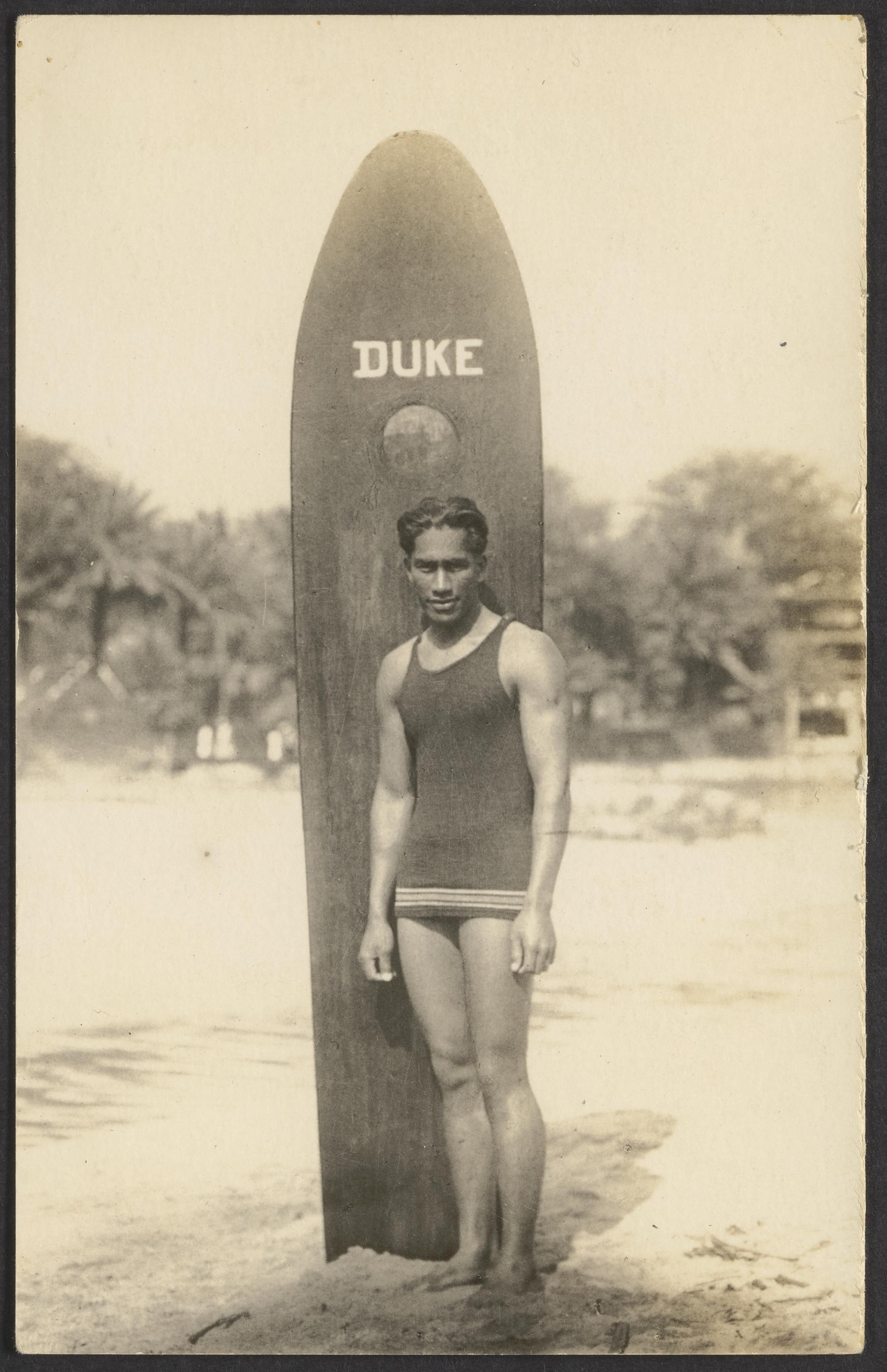

Duke Kahanamoku standing with a wooden surfboard that is planted in the sand and has his name written at the top.
Duke Kahanamoku became one of Hawaii's best-known athletes, making his mark as both a swimmer and surfer. Source: "People - Kahanamoku, Duke," accessed via Digital Archives of Hawaii.

In April 1896, 280 amateur athletes from 13 countries gathered in Athens, Greece to compete in the first modern Olympics. The early Olympic movement struggled to gain momentum, but it helped spark the rise of amateur organized sports across the United States in the early twentieth century.

On the other side of the world around the same time, the formerly independent kingdom of Hawaii was undergoing immense political change: their last monarch, Queen Lili‘uokalani, had been overthrown by American businessmen with the backing of US Marines in 1893, and the islands were annexed as an American territory in 1898.

It was during this period of upheaval that future Hawaiian Olympian Duke Kahanamoku first learned to swim.

__

Duke Paoa Kahinu Mokoe Hulikohola Kahanamoku was born on August 24, 1890, in Honolulu, Hawaii to a prominent family who were trusted advisors to the Kamehameha royal family. When Duke was young, his mother moved their family to Waikiki, in part to escape the unrest after the Queen was deposed.

As a teenager, Duke attended the Kamehameha School for Boys, a school created for Native Hawaiian students. There, students were banned from speaking Hawaiian and forced to speak English, adopt American customs, and leave much of their own culture and traditions behind.

Duke eventually left school before graduating, though, and began to spend nearly every free moment in the water, swimming, paddling, surfing, and fishing alongside other Hawaiian “watermen”—skilled ocean experts who spent their lives in and around the sea. For Native Hawaiians, the ocean was not just a place for recreation. It was tied to their culture, survival, and identity.

As the American businessmen and missionaries attempted to chip away at this culture, they also began to form their own athletic clubs like those that were starting to become popular on the mainland. They created organizations like the Outrigger Canoe Club, among others, that hosted swimming and rowing competitions which attracted tourists and local crowds alike.

However, many of these clubs were racially segregated, with membership limited to wealthy white businessmen and missionaries. Native Hawaiians were being excluded from the very sports and beaches that had been part of their culture for generations. In 1908, shut out from these whites-only clubs, Duke and his friends founded Hui Nalu, the “Club of the Waves.”

Unlike many clubs at the time, Hui Nalu welcomed people from different backgrounds. Together, its members surfed, swam, paddled, and helped revive surfing in Hawaii, which had long been of cultural importance but was in decline as a result of colonization.

After the creation of Hui Nalu, Duke became eligible to compete in Hawaii’s first competitive swim meet, held by the Amateur Athletic Union (AAU) in Honolulu in 1911. Though still relatively unknown in the swimming world, Duke was by then a practiced swimmer. He shattered American records, finishing the 100-yard freestyle in 55.4 seconds and the 50-yard freestyle in 24.2 seconds.
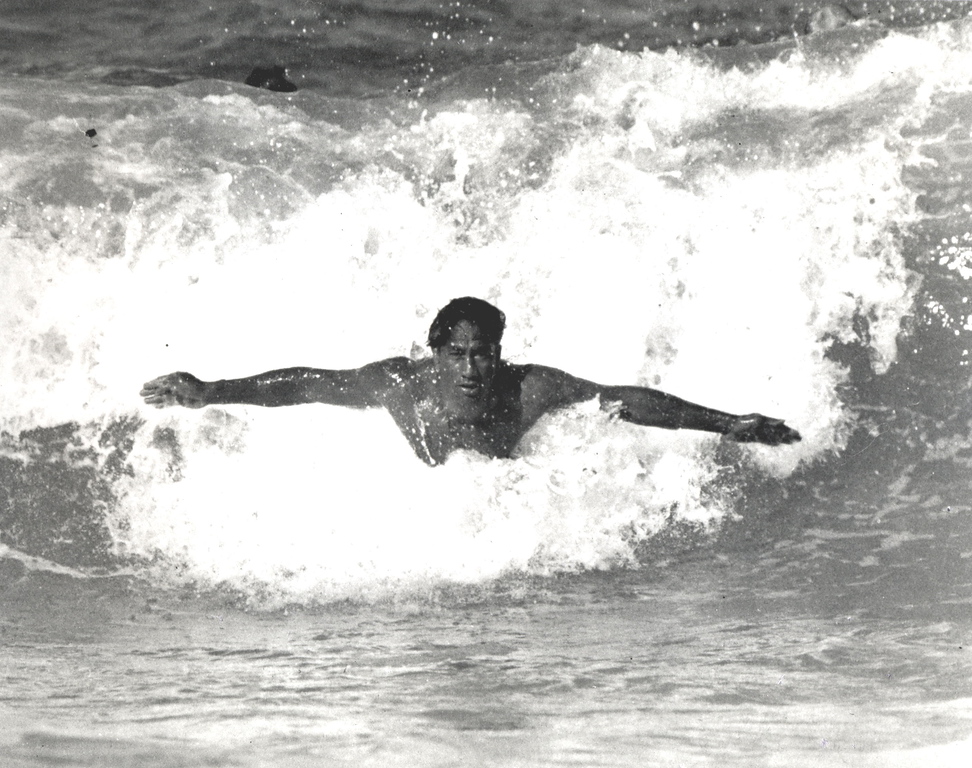
Black and white photograph of Duke Kahanamoku bodysurfing.
Kahanamoku learned to swim on the beaches of Waikiki, in open water. When he began his competitive career, he was forced to quickly adapt to indoor pool swimming for the first time. Image Source: "Duke Paia Kahanamoku," accessed via  Digital Archives of Hawaii.

Despite proving himself in Hawaii, officials on the mainland doubted his times. They questioned whether someone from Hawaii could really swim that fast. They told him that in order to certify his record-breaking times, he would have to travel across the United States to compete against the country’s top swimmers at the Olympic trials in Philadelphia. With the help of his community, he raised the money for the trip and won again, despite having little practice swimming indoors. He had officially earned his spot on the team, and was headed to the 1912 Stockholm Olympics.

When he arrived in Sweden, some of the crowd did not think he should be competing for the United States, as Hawaii was still a territory at the time, often incorrectly referring to him as “foreign.” As the first Native Hawaiian athlete to compete on the US Olympic team, and one of very few athletes of color in Stockholm, Duke faced additional pressure not only to represent the United States, but also to honor Hawaii and the Hawaiian people.

He was nearly disqualified during the semi-final round due to a scheduling miscommunication among the American team that caused them to miss the event, but they were given a second chance and Duke once again swam it in the fastest time, setting a new world record in the process.
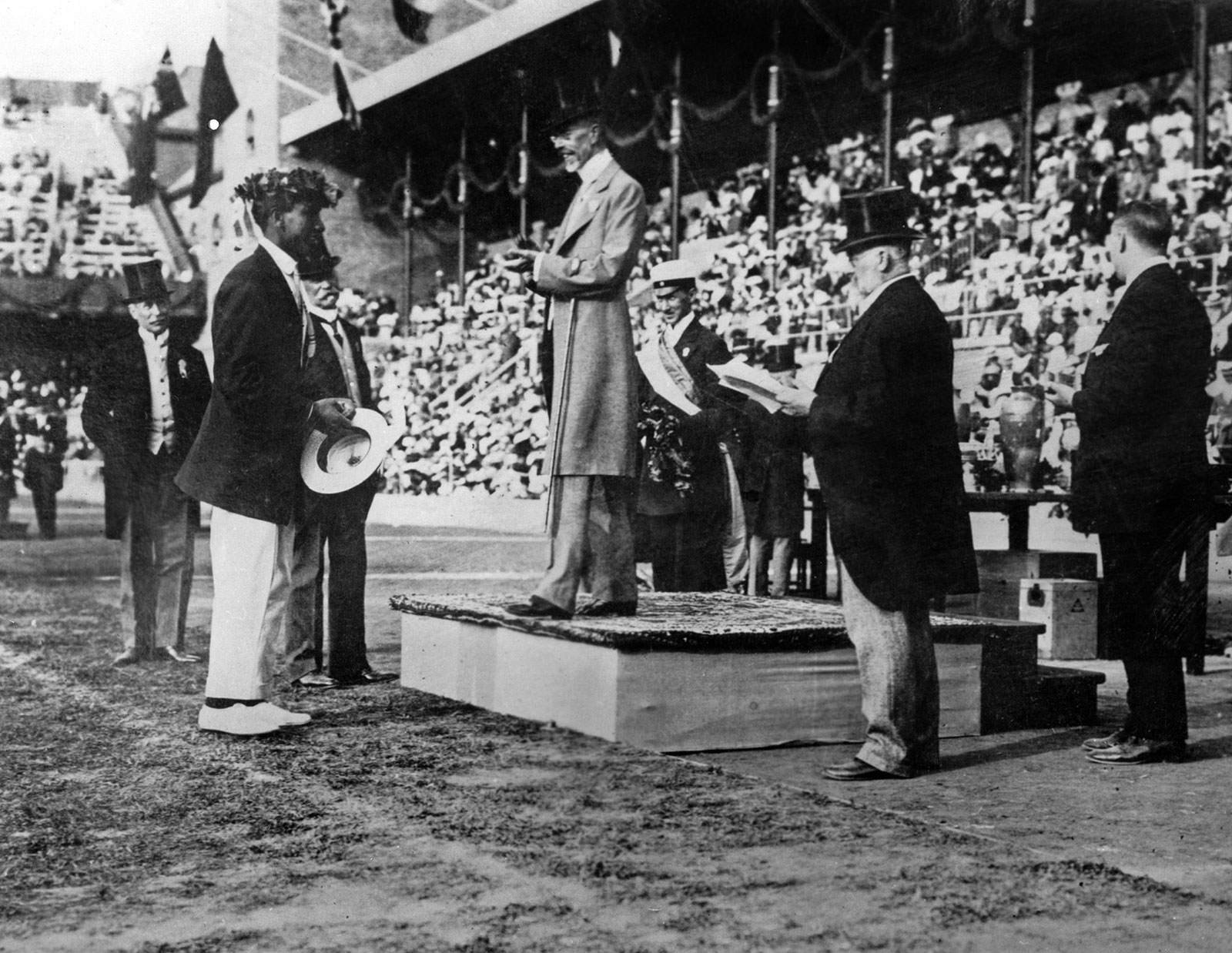
Black and white photograph of Duke Kahanamoku with the King of Sweden during a ceremony in the 1912 Stockholm Olympics.
After his Olympic victory in 1912, Duke was honored by the King of Sweden, which he later said was one of the proudest moments of his life. It was a sign that his achievements had earned international respect. Image Source:  Accessed via the International Surfing Association.

When it came time for the finals, Duke was quick to erase any doubts spectators may have had in him: he won the gold medal in the 100-meter freestyle and a silver in the 4x200-meter relay. His speed was credited to his unique “ Kahanamoku Kick”—a variation of the Australian crawl stroke which, in combination with his 6’ 1” stature and size 13 feet, allowed him to move through the pool faster than the field of better-known swimmers he was competing against. It was the first, but not the last, time he would call himself an Olympic champion, and the fastest sprinter in the world.

After the Olympics, Duke traveled back to the United States, where he is believed to have given some of the first surfing exhibitions ever to take place on the East Coast, in Atlantic City and Rockaway Beach in Queens.

Duke was expected to win big once again at the 1916 Olympics, but they were canceled after the outbreak of World War I. It would now be eight years instead of four before Duke could defend his title. During that time, he continued competing in other swimming competitions, while also getting involved in other sports in Hawaii. He competed in rowing events, joined water polo teams, popularized beach volleyball, and experimented with aquaplaning, an early form of waterskiing and wakeboarding. Around this time, he completed his legendary “Long Ride,” surfing a massive wave for what some estimated was more than a mile.
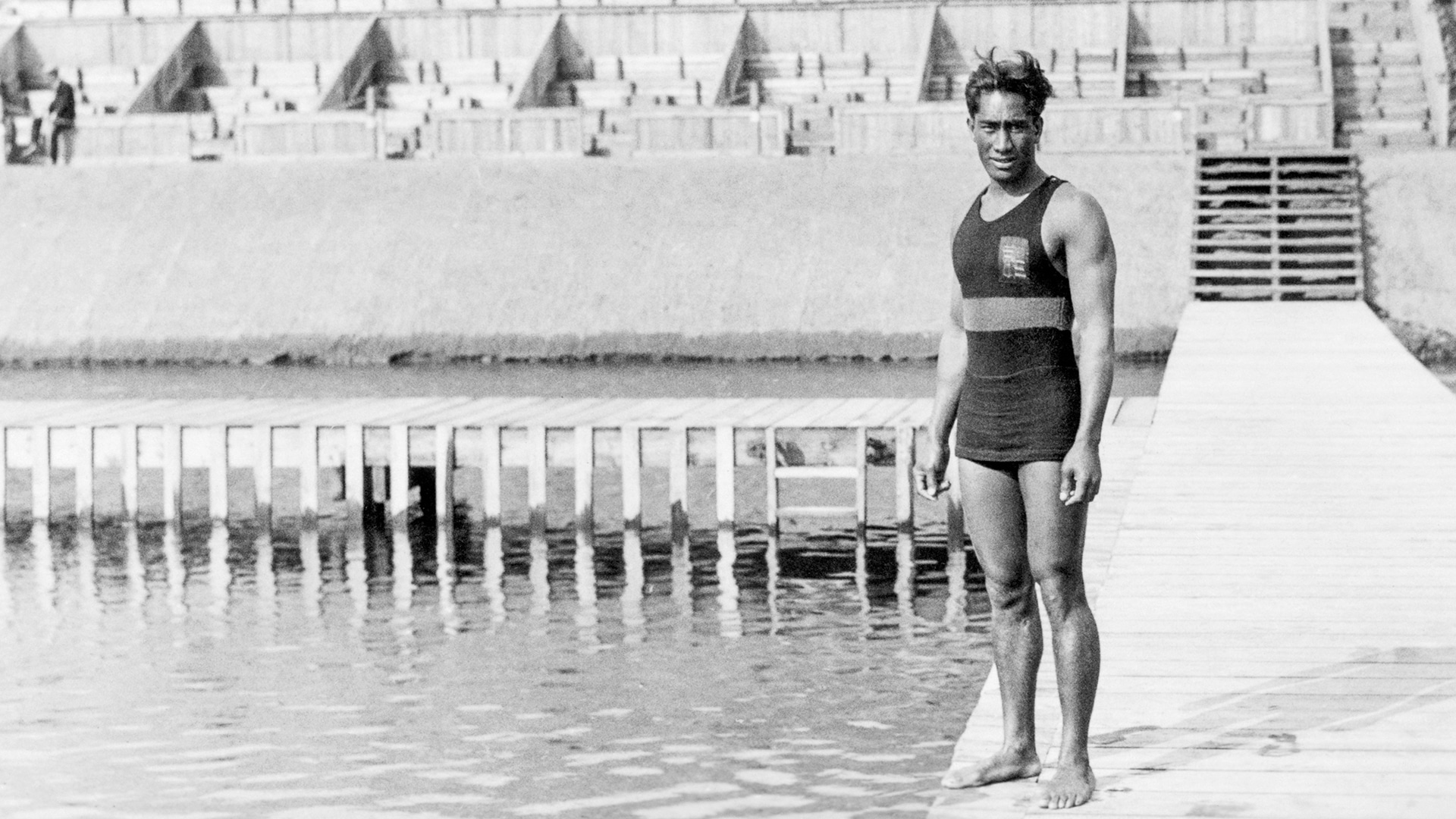
Duke Kahanamoku standing poolside at the Olympics.
When World War I broke out, the future of the Olympics became very uncertain. The 1916 games, which were scheduled in Berlin, had to be canceled, and Duke would not get the chance to defend his Olympic record until eight years after he first won gold. Image Source: Accessed via the International Olympic Committee .

He traveled often, promoting Hawaiian culture and sport wherever he went. In Australia, his surfing demonstrations inspired a new generation of surfers, helping to introduce and popularize the sport internationally. It was these travels that earned him his reputation as the “father” of modern surfing. Unfortunately, Duke often encountered prejudice while traveling. He was denied service at restaurants, called racist names, and sometimes struggled to train because many pools and beaches were racially segregated.

The years during and after World War I presented additional personal challenges for Duke. His father died suddenly in 1917, and Duke took on more responsibility for helping support his family. Although Duke explored joining military aviation service during World War I, he became seriously ill, having caught the deadly flu strain that caused the 1918 Spanish Influenza pandemic. By the time he had recovered, the armistice had already occurred, and he never served overseas—though he was still unfairly attacked for remaining at home, and even successfully sued one of Hawaii’s newspapers for defamation after they harshly criticized him.

Duke also faced financial challenges because he was required to follow strict rules that barred him from earning any money from his sport in order to maintain his Olympic eligibility. He could not accept payment for exhibitions, endorse products, or even work as a swim or surf coach. The system favored wealthy athletes who could afford to train at the level Olympic competition required without pay. Conversely, Duke had to balance his preparation with other work to survive.

The amateur rules also caused problems as Duke moved to California in the 1920s to pursue a career in Hollywood. Movie studios were drawn to his athletic fame and strong screen presence. However, strict amateurism rules meant he couldn’t appear in films that featured swimming or water stunts without risking disqualification from future competition.

In addition, racial prejudice limited the kinds of characters nonwhite actors were allowed to play, and Duke was often cast as stereotyped “Native chiefs” rather than leading roles. Even so, he appeared in numerous films throughout the 1920s, though like many silent films from this era, several of them are either completely or partially lost.

Despite these challenges, Duke returned to Olympic competition in 1920 at the Antwerp Games. The journey there presented more obstacles, though: the conditions on the ship that was bringing the athletes to Belgium, the Princess Matoika, were very poor. It had just been used to transport the bodies of 1,800 American soldiers who had died in the war, and so the ship smelled of formaldehyde and was infested with rats. The athletes also lacked space or equipment to train.

The poor conditions sparked what became known as the “ Mutiny on the Matoika,” when 200 athletes—including Duke—signed a letter demanding better treatment and accommodations. This is considered one of the first times athletes collectively advocated for themselves, and their efforts led to improvements and reforms in the years to come.

The challenges did not end there: Duke was the fastest swimmer in the 100-meter freestyle finals, but after one swimmer claimed there had been a foul, officials required a redo. Luckily, during the second swim, he held onto his first-place finish and became the first person ever to win gold at this event at two consecutive Olympics. He also helped the relay team earn another gold medal.
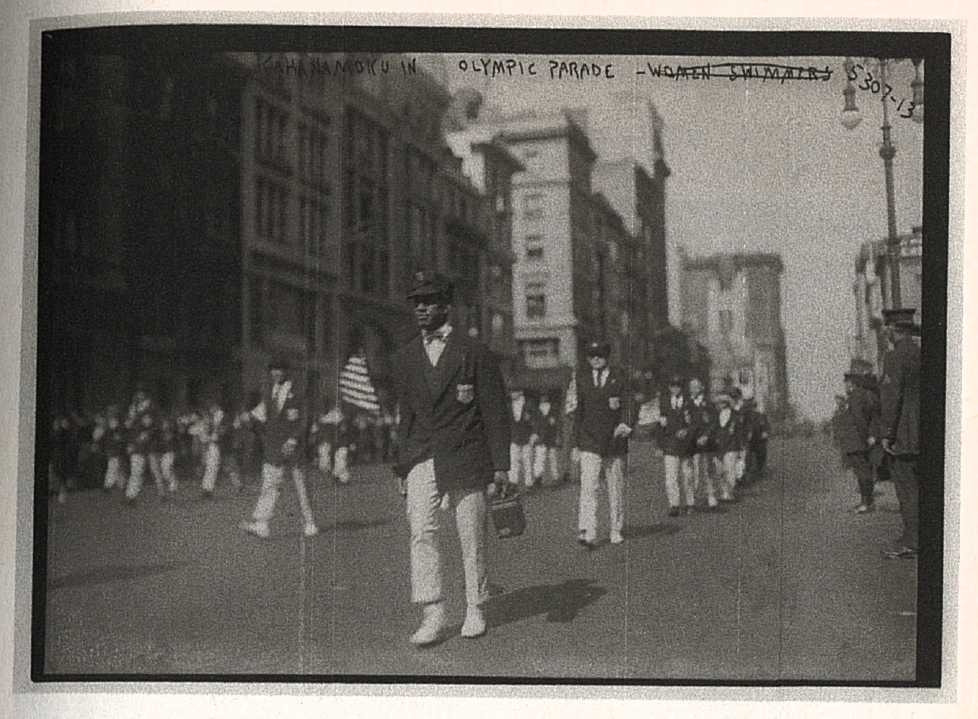
Duke Kahanamoku marching in the ticker tape parade held in Manhattan after the 1920 Antwerp Olympic games.
Duke visited New York City several times throughout his life, including in 1920, when he marched in the ticker tape parade thrown in Manhattan to celebrate the Olympic Champions returning from Antwerp. Image Source: Balf, T. (2024). Three Kings [Hardcover]. Blackstone Publishing, Inc.

By this time, Hawaii had become known for producing world-class swimmers, thanks in large part to Duke’s influence—in fact, the entire podium for the 100-meter race was made up of Hawaiian athletes. But as the next Olympic cycle approached, the landscape of competitive swimming was shifting. A new generation of athletes was emerging, and by 1924, Duke—now in his early thirties—faced questions about whether he would even try out for the upcoming Paris Olympics. If he did, he’d be facing his toughest competition yet: Johnny Weissmuller.

Weissmuller, who would later become popular for playing Tarzan, was a member of the Illinois Athletic Club in Chicago, which had a longtime rivalry against Hawaiian swimmers. He was younger than Duke and had been chipping away at each of his sprinting records. However, the two would not meet in competition for several years, until Duke decided he would, in fact, race in the Olympic trials.

The qualifying race was highly anticipated, as spectators gathered to see who the fastest man in the world really was. Weissmuller beat Kahanamoku—but just barely, only touching the wall six-tenths of a second before Duke. Both men had earned spots on the team, though Duke was only given a spot in one event—the 100-meter freestyle. Many Hawaiians suspected the coach—who was also Weissmuller’s coach in Chicago—of favoritism.
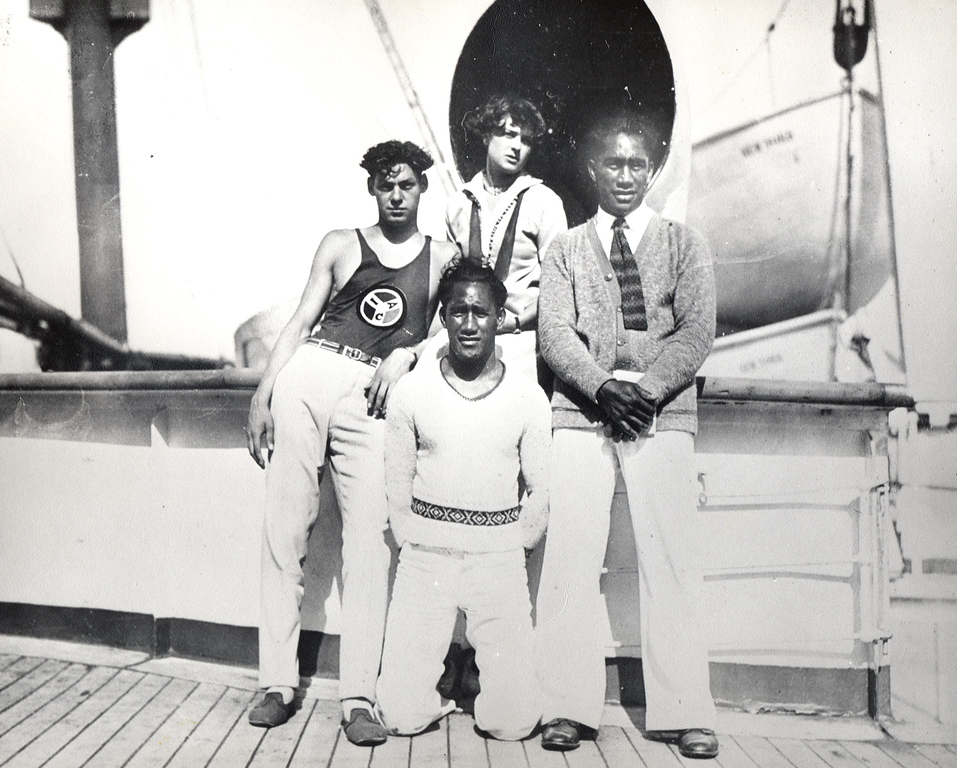
Four people, Johnny Weissmuller (left); Aileen Riggin (center, back); Duke Kahanamoku (right); and David Kahanamoku (kneeling); en route to the 1924 Paris Olympics.
For fans of swimming in the 1920s, there was no sprinting matchup that was more anticipated that Duke Kahanamoku versus Johnny Weissmuller. Though competitive in the pool, the two men remained friends for life. Here, Weissmuller (left) and Kahanamoku (right) are pictured along with fellow Olympian Aileen Riggin (center, back) and Duke's brother David (kneeling), all en route to the 1924 Paris Olympics. Image Source: Accessed via  Outrigger Canoe Club Archives.

Nevertheless, Duke had once again proved his detractors wrong: his times were good enough that he was still considered a contender for a “three-peat” in the 100-meter, 12 years after he had first won gold. When the moment came in Paris, however, Weissmuller won the gold medal, while Duke earned silver. His brother Sam won bronze. Even in defeat, Duke showed grace and sportsmanship, and he and Weissmuller remained friends for the rest of their lives.

The year after the Paris Olympics, Duke made headlines again, not as the fastest man in the world, but as a real-life hero. When a boat capsized in rough surf near Corona del Mar, he paddled into the dangerous waves and used his surfboard to bring several people to safety. In total, he helped save eight lives, in what is now remembered as one of the earliest recorded uses of the modern surf rescue technique.

Despite his heroism, Duke was denied a Carnegie Medal for bravery. Officials claimed he was ineligible because Hawaii was not yet a state, even though white residents of Hawaii and Alaska had received the same honor under identical territorial status. Many believed racial prejudice, not a technicality, was the real reason for the denial.
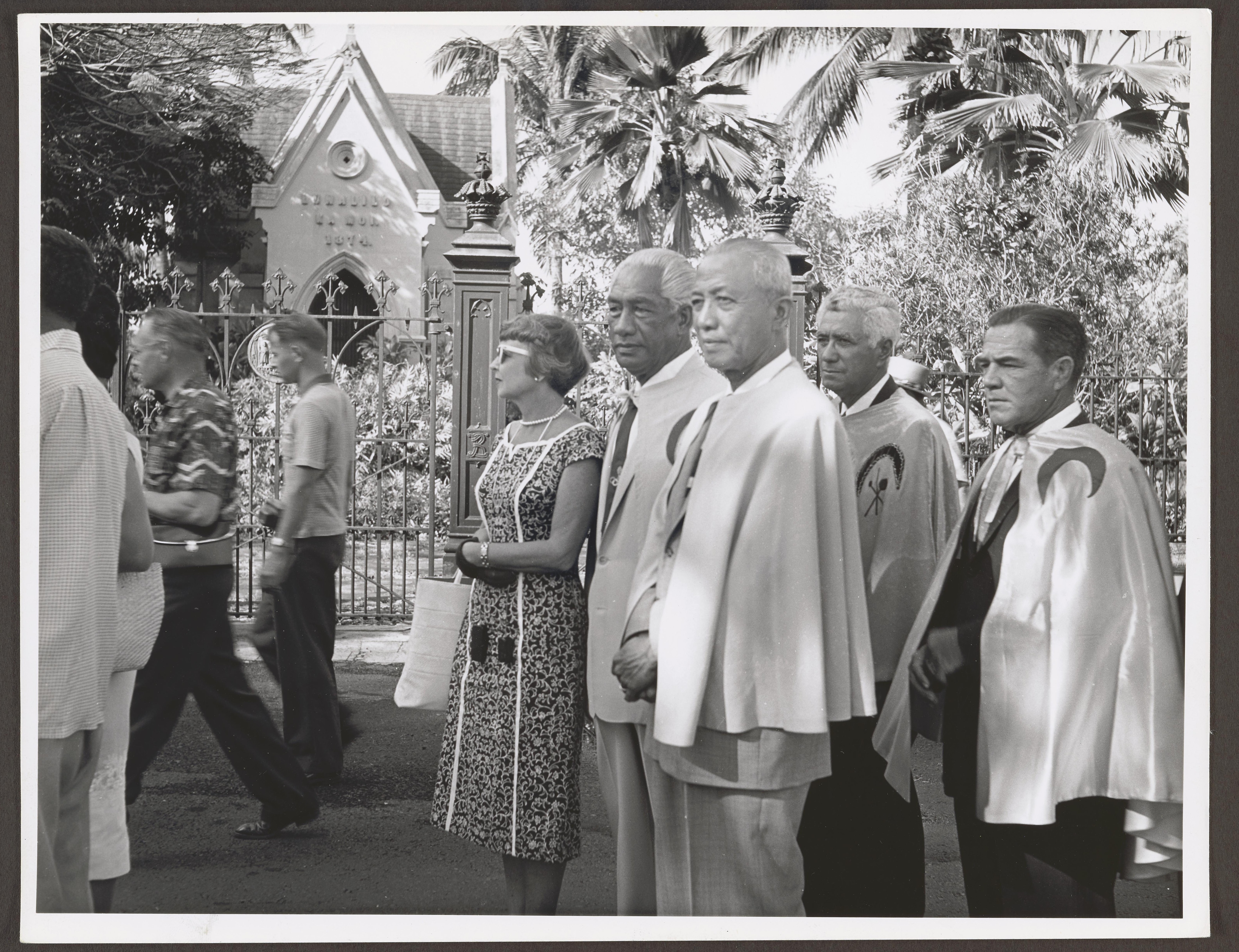
Black and white photograph of Duke, center, and his wife Nadie, left, at Hawaii's statehood celebration.
As a Hawaiian at the turn of the twentieth century, Kahanamoku lived through immense political change. When he was born, the islands were still their own independent kingdom. As a child, he saw the monarchy overthrown as Hawaii became an American territory. As an adult, he had become such a beloved member of his community that he was invited to attend a celebration of Hawaii's ratification as the fiftieth state in 1959, alongside his wife Nadine (left). Image Source: "Statehood - Celebration," accessed via Digital Archives of Hawaii.

After his eventual retirement from competitive swimming, Duke settled down: he married Nadine Alexander in 1940 and was elected to serve as Honolulu’s sheriff, a post he held for nearly thirty years. When Hawaii became the fiftieth state and the position of sheriff was eliminated, he was named Hawaii’s official greeter, welcoming tourists, politicians, actors, and more to the beaches that he called home. As one of Hawaii’s best-known public figures, Duke also used his influence to advocate for the protection of Hawaii’s coastline and environment as the tourism industry grew.

In the later years of his life, he became the elder statesman of the water sports he loved. He helped coach an undefeated team at the Outrigger Canoe Club, which had made an exception to allow him to join in 1917. Over time, he saw improvements to surfboard materials, from his hundred-pound redwood board to lightweight foam and fiberglass that allowed riders to create new styles and innovative tricks. Even pool attire changed, with new swimsuits made from synthetic materials that allowed athletes to move faster than was possible in the heavy wool bathing costumes of his day.
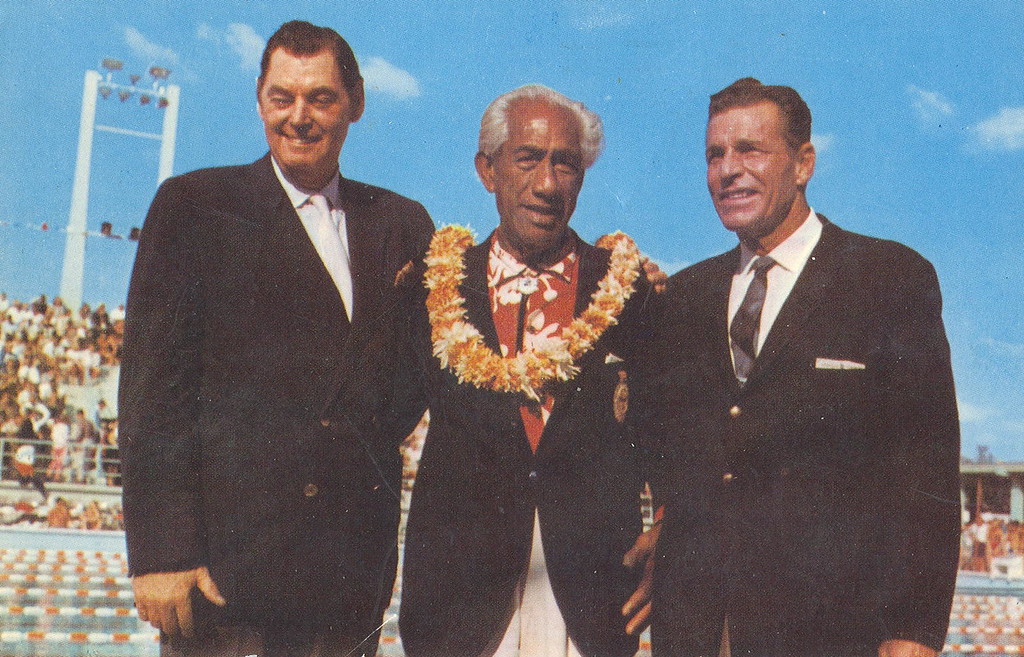
Johnny Weissmuller, Duke Kahanamoku, and Buster Crabbe during their induction into the inaugural class of the Swimming Hall of Fame.
Duke (center) received many honors throughout his career as one of Hawaii's most famous athletes, including being inducted into the inaugural class of the Swimming Hall of Fame alongside his competitors Johnny Weissmuller (left) and Buster Crabbe (right). Image Source: accessed via Outrigger Canoe Club Archives.

When Duke died of a heart attack on January 22, 1968, at age 77, he was one of the most beloved Hawaiians of all time. Today, he is remembered for far more than his Olympic medals. Before the Beach Boys or Gidget made surfing mainstream, Duke helped revive and spread the sport across the globe. In 1999, he was named Surfer of the Century by Surfer Magazine. At the 2020 Olympics, his dreams of surfing becoming an Olympic sport were finally fulfilled, and Carissa Moore, also a Native Hawaiian athlete, became the first woman to take home a gold medal in surfing—bringing Duke’s vision full circle.

Having challenged racial barriers in sports long before many better-known civil rights pioneers, Duke paved the way for future generations of athletes across all sports. His influence can even be said to extend to skateboarding and snowboarding, which both evolved from surfing. Statues, beaches, competitions, and schools now bear his name, but his greatest legacy remains the spirit he carried both in and out of the water: joy, generosity, and aloha.
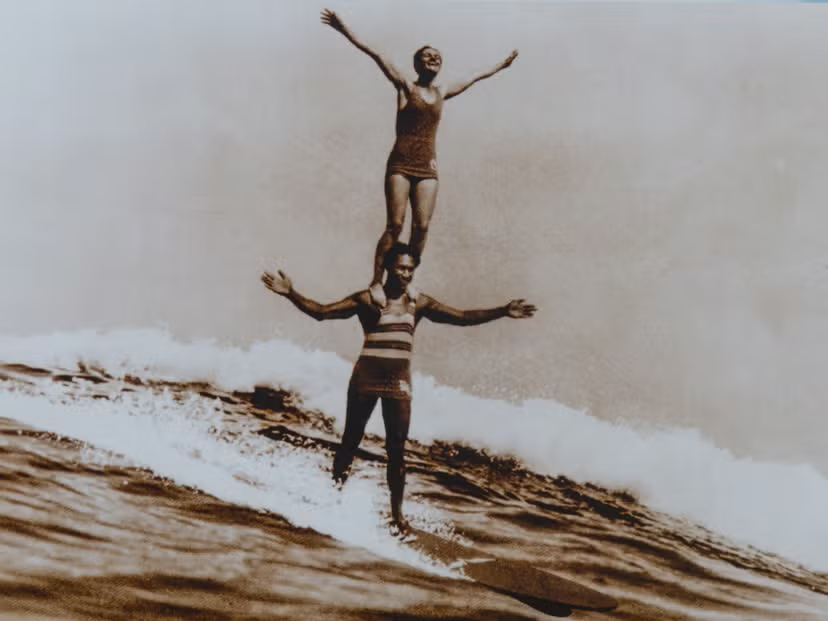
A man, Duke Kahanamoku, surfing with his arms out on a wave, with a woman, Viola Hartman, standing on his shoulders.
As Duke once said, “The best surfer out there is the one having the most fun.” Image Source: MediaNews Group / Orange County Re / MediaNews Group via Getty Images; Accessed via PBS SoCal.

Sources

  • Alexander, K. L. (2020). Queen Lili‘uokalani. National Women’s History Museum. https://www.womenshistory.org/education-resources/biographies/queen-liliuokalani
  • Aquino, L. (2021). Native Hawaiian Olympians Honored in 100-Foot Mural in the Birthplace of Surfing on the Heels of the Sport’s Olympic Debut [Press Release]. Business Wire. https://www.businesswire.com/news/home/20211213005339/en/Native-Hawaiian-Olympians-Honored-in-100-Foot-Mural-in-the-Birthplace-of-Surfing-on-the-Heels-of-the-Sports-Olympic-Debut
  • Balf, T. (2024). Three Kings: How Record-Smashing Swimmers Johnny Weissmuller, Duke Kahanamoku, and Katsuo Takaishi Changed Their Sport and Each Other Forever [Hardcover]. Blackstone Publishing, Inc.
  • Barr, J. (2020, August 14). Team USA’s success at Antwerp 1920. United States Olympic & Paralympic Museum Spotlight. https://usopm.org/100-years-later-looking-back-at-team-usas-success-at-antwerp-1920/
  • Beschloss, M. (2014, August 22). Duke of Hawaii: A Swimmer and Surfer Who Straddled Two Cultures. The New York Times. https://www.nytimes.com/2014/08/23/upshot/duke-of-hawaii-a-swimmer-and-surfer-who-straddled-two-cultures.html
  • Davis, D. (2015). Waterman: The life and times of Duke Kahanamoku [Paperback]. University of Nebraska Press.
  • Hall, S. (2021, June 10). Duke Kahanamoku Brings Surfing to the Stockholm 1912 Games. International Surfing Association. https://isasurf.org/duke-kahanamoku-surfing-stockholm-1912-games-sandy-hall/
  • History.com Editors. (2009, November 24). First Modern Olympic Games. A&E Television Networks. History. https://www.history.com/this-day-in-history/april-6/first-modern-olympic-games
  • International Olympic Committee. (2020, September 11). The legend of Duke Kahanamoku, the father of modern surfing and double Olympic champion in Antwerp. Olympic News. https://www.olympics.com/en/news/the-legend-of-duke-kahanamoku-the-father-of-modern-surfing-and-double-olympic-ch
  • IOC. Duke Paoa Kahanamoku. International Olympic Committee. Retrieved from https://www.olympics.com/en/athletes/duke-paoa-kahanamoku
  • Jennings, L. A. (2016, June 7). For Love or For Money: A History of Amateurism in the Olympic Games. VICE. https://www.vice.com/en/article/for-love-or-for-money-a-history-of-amateurism-in-the-olympic-games/
  • Jew, V. (2022). Duke Kahanamoku: Olympic Gold Medalist, Politician, and Father of Modern Surfing. In Hidden Voices: Asian Americans and Pacific Islanders in United States History (Vol. 1). NYC Department of Education. https://www.weteachnyc.org/resources/resource/hidden-voices-asian-americans-and-pacific-islanders-in-united-states-history/
  • Jones, D. (2015, October 1). The Ultimate Waterman. Surfer. https://www.surfer.com/news/duke-kahanamoku-biography
  • Kahanamoku, S. (1984, October 31). Oral History: Duke Paoa Kahanamoku (K. Pratt, Interviewer) [Transcript]. Outrigger Canoe Club. https://www.outriggercanoeclubsports.com/occ-archives/oral-histories/duke-paoa-kahanamoku/
  • Little, B. (2018, February 15). How Snowboarding Became Mainstream. A&E Television Networks. History. https://www.history.com/articles/how-snowboarding-became-a-mainstream-olympic-event
  • Lombardo, C. (2022, April 21). 13 nearly forgotten Hollywood films that feature Duke Kahanamoku. PBS American Masters. https://www.pbs.org/wnet/americanmasters/duke-kahanamokus-hollywood-films/21325/
  • Malama Pono Inc. (2019). The Duke Kahanamoku Story. Duke Kahanamoku. https://dukekahanamoku.com/the-duke-kahanamoku-story/
  • Outrigger Canoe Club. Winged “O” Duke Paoa Kahanamoku. OCC Sports. Retrieved from https://www.outriggercanoeclubsports.com/winged-o/duke-kahanamoku/
  • Roos, D. (2020, March 24). When World Events Disrupted the Olympics. HISTORY. https://www.history.com/articles/olympics-postponed-cancelled
  • Rothman, L. (2015, August 24). Duke Kahanamoku: How He Saved Lives With His Surfboard. Time. https://time.com/4007897/duke-kahanamoku-surf-hero-history/
  • Shinn, P. (2022, May 23). Duke Kahanamoku—Olympic Swimming Legend, Father of Surfing, & Ambassador of Aloha. US Olympic Committee. Team USA. https://www.teamusa.com/news/2022/may/23/duke-kahanamoku-olympic-swimming-legend-father-of-surfing-ambassador-of-aloha
  • Skinner, J. (2022, May 3). Duke Kahanamoku biography and life timeline. PBS American Masters. https://www.pbs.org/wnet/americanmasters/duke-kahanamoku-biography-and-life-timeline/21754/
  • SurferToday. (2017, February 22). This Is Your Life—Duke Kahanamoku (Father of Surfing): February 20 1957 [Television]. Originally aired by NBC. https://www.youtube.com/watch?v=L_oyVdxKYiE
  • The Foundation for Global Sports Development. (2022, April 21). 6 ways Duke Kahanamoku’s athleticism changed sports. PBS American Masters. https://www.pbs.org/wnet/americanmasters/duke-kahanamokus-athleticism-innovation-records/21601/
  • The New York Times. (2015, August 24). Duke Kahanamoku, Legendary Surfer and Swimmer, Gets Google Tribute. The New York Times. https://www.nytimes.com/2015/08/25/sports/duke-kahanamoku-hawaiis-best-known-citizen-is-back-in-the-spotlight.html
  • Time Magazine. (1968, February 2). Duke Kahanamoku Obituary. TIME, 91(5), 65. https://time.com/vault/issue/1968-02-02/page/65/  
  • United States Olympic & Paralympic Museum. (2019, July 20). Duke Kahanamoku: Swimming. United States Olympic & Paralympic Museum Hall of Fame. https://usopm.org/duke-kahanamoku/
  • Walker, I. H. (2022, April 22). How Native Hawaiian surfers used the ocean as sanctuary. PBS American Masters. https://www.pbs.org/wnet/americanmasters/duke-kahanamoku-hawaii-history-surfing/21608/
  • Winner, T. (2018, June 7). Sidewalk Surfing: The Gnarly History of Skateboarding Part I (1940s to 1972). The Strong National Museum of Play. https://www.museumofplay.org/blog/sidewalk-surfing-the-gnarly-history-of-skateboarding-part-i-1940s-to-1972/
  • Zambrano, M. (2022, May 10). Duke Kahanamoku and the Origins of Surfing in Orange County. PBS SoCal. https://www.pbssocal.org/shows/american-masters/duke-kahanamoku-gave-birth-to-surf-culture-in-orange-county

Cover photo: Duke Kahanamoku Surfing in 1910 (left) accessed via PBS SoCal; Duke Kahanamoku Negatives (right) accessed via Digital Archives of Hawaii; Waikiki Beach and Rainbow (background) accessed via Pexels.

Technology for families

Students

Access all your DOE applications – TeachHub, Google, iLearnNYC, Microsoft Office, Zoom, and more–from one place.

SupportHub

Need technical support? Visit the SupportHub for answers to common questions and to open a support ticket.

NYC Schools Account (NYCSA)

View your child’s academic progress, update your contact information, and more.

Parent University

Parent University seeks to educate and empower families through free courses, resources, events, and activities.

MySchools

Apply to grades 3-K –12, explore and compare schools, and more.

Expand Footer Collapse Footer
New York City Department of Education

Enrollment

  • Enroll Grade by Grade
  • Enrollment Help
  • Enroll in Charter Schools
  • Summer
  • Other Ways to Graduate

Learning

  • Special Education
  • Multilingual Learners
  • Digital Learning
  • Subjects
  • Testing
  • Student Journey
  • Programs

School Life

  • Accessibility at the DOE
  • Health and Wellness
  • Food
  • Transportation
  • Know Your Rights
  • School Environment
  • Safe Schools
  • Special Situations
  • Space and Facilities

Connect with NYCPS

  • Employees
  • Careers
  • About Us
  • News
  • Calendar
  • Messages for Families
  • InfoHub
NYC Public Schools logo

Copyright ©  New York City Department of Education.

Sitemap | Privacy Policy
X icon YouTube Facebook Instagram
Follow Us
  • (Open external link)
  • (Open external link)
  • (Open external link)
  • (Open external link)
Top